University Admissions
UK vs US Master's Applications: What Actually Changes?
UK and US Master's applications look similar and reward different things. Subject anchored statements, narrative essays, leadership evidence, networking, funding and what sticker price really means.
Deep Biswas · Published 9 August 2026 · 8 min read
On this page
- UK Master's applications tend to stay anchored in the subject
- US applications often allow a narrative arc
- Leadership and experience outside the classroom
- Networking and demonstrated interest
- Public and private universities in the USA
- Sticker price is not always the price
- Similar prestige, different institutions
- Comparing programmes beyond rankings
- Framing a CV or résumé for the US
- A statement of purpose is not a personal statement
- The decision is wider than the application
- "Studying in America" is not one experience
- Where support actually helps
A UK Master's application and a US Master's application can look, on the surface, like the same task. Both ask for your academic record, both want to know why you are applying, and both involve writing something about yourself. Applicants therefore assume that one strong application can be sent in two directions.
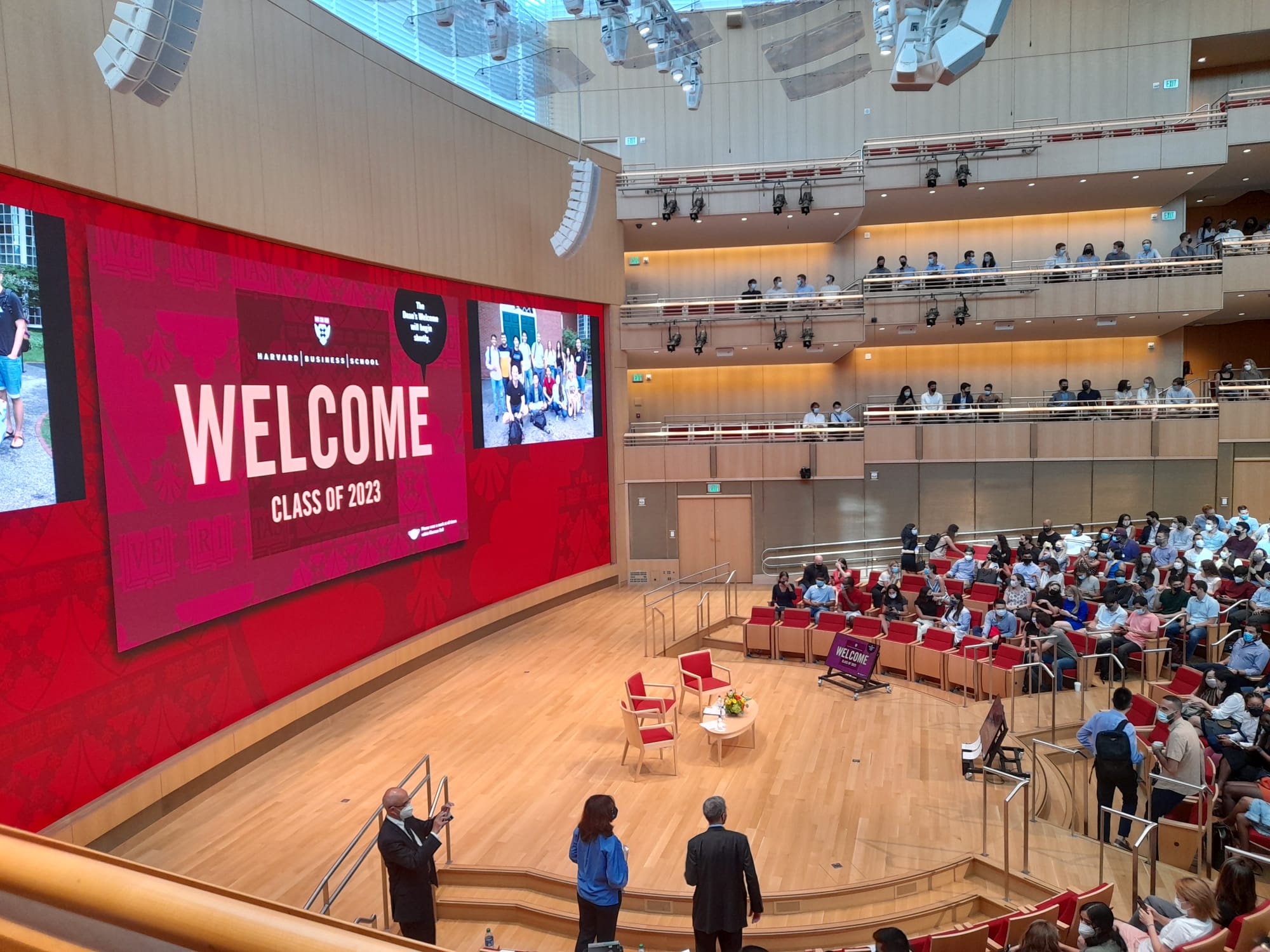
Having studied at Cambridge and at Harvard Business School, and having gone through both admissions environments, I would not make that assumption. The differences are not primarily about formatting. They are about what each system is inviting you to communicate, and how much weight different institutions place on academic depth, personal narrative, leadership, ambition, contribution, programme fit and professional trajectory. These are tendencies rather than rules, and individual programmes vary widely, but the tendencies are real enough to plan around.
UK Master's applications tend to stay anchored in the subject
Many UK Master's applications remain firmly about the discipline. The questions being answered, whether or not they are asked explicitly, are why this subject, what you have already studied, which academic questions genuinely interest you, what research or professional experience is relevant, why this particular programme and how it forms a logical next step.
The strongest UK applications I see tend to follow a clear progression: this is what I have studied, this is what interests me within it, this is what I now want to understand more deeply, and this programme is the logical place to do that. Personal material can still matter, but the subject usually remains the anchor, and material that drifts away from it tends to feel like padding.
US applications often allow a narrative arc
US admissions writing frequently allows, and sometimes rewards, something closer to a narrative. An essay may be built around a formative experience, a challenge, a turning point, a period of personal development, a moment of realisation or a broader ambition that emerged from all of it.
To a British applicant this can feel almost theatrical the first time they read successful examples. It is worth being clear about what I am not saying. The objective is not to manufacture a story. It is to understand that US applications may give you greater permission to explain the story behind your ambitions, where a UK application often expects you to leave it out.
Some of this may reflect broader cultural tendencies rather than admissions rules. British culture can be comparatively private and understated, and applicants are often less accustomed to talking explicitly about themselves, articulating ambition, foregrounding achievement or presenting their own development as a narrative. US culture is frequently more comfortable with all of that. Neither is better. The practical point is that an applicant should understand what a particular application is actually inviting them to communicate, and then do that well.
Leadership and experience outside the classroom
In US applications especially, experience beyond formal academic work can become genuine evidence rather than decoration. Sport, community involvement, entrepreneurship, volunteering, international experience and social impact work all qualify.
Sport is the example I use most often, because it is so commonly undersold. Playing seriously can signal discipline, resilience, teamwork, leadership, sustained commitment and performance under pressure. The question a reader is answering is not what activities you have done. It is what those activities demonstrate about you, and whether you understand that yourself.
Networking and demonstrated interest
This is the difference I was least prepared for. Operating within the UK system, I had not appreciated how normal it is in the United States to investigate a university socially and professionally as well as academically.
US applicants will often speak to current students, contact alumni, join information sessions, attend webinars, engage with admissions representatives, visit campus where possible and learn in detail about particular clubs, courses and career pathways before they apply. I had approached UK university selection much more from inside an academic bubble: read about the course, read about the faculty, apply.
None of this implies that networking improperly influences a decision, and it should not be treated as a route around the substance of an application. The value is genuinely informational. You learn what the institution is actually like, you understand the culture of the programme, you make a better decision about where to go, and you are then able to articulate specific programme fit rather than writing something that could be sent anywhere. Applications that are informed simply read differently from applications that are generic.

Public and private universities in the USA
The US market contains a very visible distinction between private universities, supported by endowments, alumni giving, philanthropy and donors, and major public universities operating under quite different funding structures.
I would not say that this maps neatly onto the UK. The public and private distinction is much less central to how applicants typically compare UK universities, which operate within a more nationally regulated higher education environment. The point for an applicant is simply that the US market can contain more visibly different institutional financial models, and those models have consequences for cost, funding and the resources you encounter once you arrive.
Sticker price is not always the price
An American university's advertised tuition figure does not necessarily equal what every student ultimately pays. Some institutions have substantial financial resources and may offer grants, scholarships, fellowships, institutional funding, assistantships where applicable and donor supported opportunities.
Two cautions matter here. First, generous undergraduate financial aid policies do not automatically extend to Master's applicants; funding at postgraduate level varies enormously by programme and by institution. Second, nobody should treat any of this as a promise of funding. What I would say is this: do not eliminate an American university on the headline tuition figure alone. Investigate the actual funding arrangements for the specific programme and work out an expected net cost before you decide.
Similar prestige, different institutions
Cambridge and Harvard are both exceptional, and I am not interested in ranking them against each other. They operate within different institutional and financial ecosystems, and that is what an applicant can usefully understand.
At a wealthy private American university I could feel the depth of resources around the course itself: facilities, programming, student activities, alumni infrastructure, career support and opportunities funded well beyond the classroom. Cambridge has extraordinary intellectual resources, history, networks and institutional wealth of its own, but it sits within a different higher education environment and the experience feels different from the inside.
That is the useful insight. Universities with similar global prestige can feel materially different once you are actually there, which is a strong argument for investigating the institution rather than the ranking.
Comparing programmes beyond rankings
A sensible comparison covers academic resources, career infrastructure, alumni networks, funding, student support, location, employer relationships, campus life, total cost and institutional culture.
International students often rely more heavily on institutional infrastructure than domestic students do, simply because they do not arrive with an existing local support network. Careers services, alumni access and student support matter more when they are the only network you have.
Framing a CV or résumé for the US
US applications and US recruiting both reward clear evidence of impact. A CV that lists responsibilities leaves the reader to infer everything.
The questions to ask of each line are what changed, what you led, what you improved, what the result was, what judgement you demonstrated and what your specific contribution was. This is not an invitation to exaggerate. It is about expressing genuine achievements clearly enough that they register.
A statement of purpose is not a personal statement
US programmes may ask for several pieces at once: a statement of purpose, a personal essay, short answers, a leadership essay, career goals and a CV or résumé. The common failure is repeating the same story in each of them.
Treat the application as a portfolio. Each component should add something the others do not, while remaining coherent with the rest. Read together, they should describe one person with one direction, seen from several angles.
The decision is wider than the application
Choosing between UK and US Master's programmes also affects total cost, available funding, exposure to exchange rates, distance from family, employment prospects, work authorisation, geographic mobility, social experience, academic culture and where you are likely to build a career afterwards.
The framework I use with applicants is deliberately simple: academic fit, career fit and personal fit. If a programme fails badly on one of the three, the other two rarely rescue it.
"Studying in America" is not one experience
It is also worth remembering that the US is not a single destination. Boston, New York, California, the Midwest and the South can differ considerably in cost, culture, climate, industries and professional networks. I studied in Boston and also spent time living in Tulsa, Oklahoma, which gave me some exposure beyond the familiar coastal environments.
For the fuller account of relocation, employment constraints, everyday logistics and social integration, see what it is really like to study abroad as an international Master's student. If you are weighing the UK side of the comparison, what it is really like to study at Cambridge covers that experience directly.
Where support actually helps
Master's admissions support is therefore not simply editing writing. In practice the useful work is UK versus USA strategy, university and programme selection, positioning, statement of purpose development, narrative development, CV or résumé work, interview preparation, funding considerations, career implications and the international relocation questions that sit behind all of it.
If you would like help comparing programmes across both systems and positioning an application accordingly, the Master's application support page sets out how that works. One to one support starts from £105 per hour, with structured programmes available at preferred package rates.
This article reflects Deep Biswas’s personal experience and professional perspective. Admissions practices, funding arrangements and programme requirements vary by institution and change over time; applicants should confirm details with the programmes themselves. My Career Impact is independent and is not affiliated with or endorsed by Harvard University, Harvard Business School or the University of Cambridge.
About the author
Deep Biswas is the founder of My Career Impact. He holds an MBA with Distinction from Harvard Business School and an MPhil from the University of Cambridge. A former UK Government economist, he provides one-to-one tutoring, university admissions coaching and consulting interview preparation.
More about Deep BiswasRelated insights
- What It Is Really Like to Study Abroad as an International Master's Student
A domestic postgraduate at Cambridge, an international one at Harvard. What actually changes when you move abroad: banking and ID, currency, housing, employment access, geography and integration.
- What Is It Really Like to Study at Cambridge?
What is studying at Cambridge University actually like? Drawing on my MPhil at Jesus College, I explain the college system, academic life, libraries, dinners, cycling, student support, careers and some of the details applicants often overlook.
- How the Harvard Business School Case Method Actually Works
A first-hand account of the HBS classroom: seating, preparation, cold calls, timing a contribution and what the method does and does not teach.